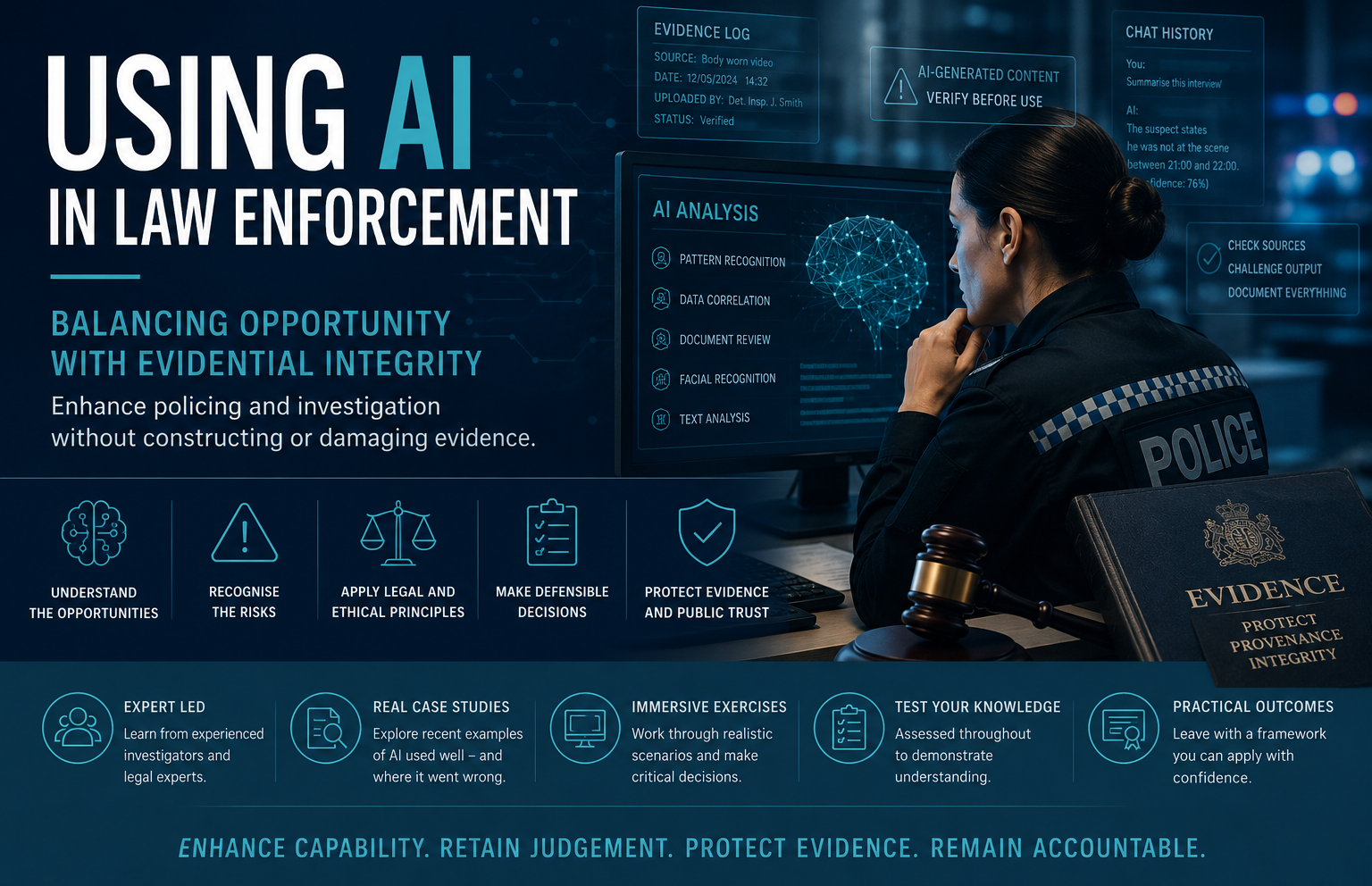
Using AI in Law Enforcement: Opportunity, Risk and Evidential Integrity

- 2 Sections
- 1 Lesson
- 1 Quiz
- 1h Duration
# Curriculum — Using AI in Law Enforcement ## 1. AI, Policing and Investigation: What Has Changed? * Generative AI, machine learning and AI-enabled investigative tools * How AI is already entering policing and investigative practice * Where AI can enhance professional capability * The difference between **assistance, augmentation and automated decision-making** * Why apparently convincing AI outputs can be wrong **Case study:** A recent example of AI use that created investigative, legal or evidential concerns. --- ## 2. Opportunity: Where Can AI Improve an Investigation? Practical exploration of legitimate applications, including: * Reviewing and organising large volumes of information * Research and information discovery * Summarising documents and material * Identifying themes, patterns, connections and inconsistencies * Supporting analytical thinking and hypothesis development * Translation and transcription * Preparing briefings, chronologies and working documents * Supporting administrative and repetitive investigative activity * Using AI to release investigator time for higher-value professional judgement **Exercise:** Delegates identify where AI could add value across an investigative scenario — and where it should not be introduced. --- ## 3. The Critical Boundary: Assistance or Evidence? Explore one of the central questions for investigators: **Is AI helping me understand the evidence — or starting to construct it?** * Original material versus AI-generated material * Evidential provenance and continuity * AI-generated summaries and interpretations * Creating or filling gaps that do not exist in the original evidence * Alteration and enhancement of images, audio and video * Synthetic material and deepfakes * Distinguishing investigative leads from evidence * Maintaining an auditable route back to the original source **Immersive challenge:** Delegates receive an AI-assisted investigative product and must determine what can safely be relied upon, what requires verification and what may have compromised evidential integrity. --- ## 4. When AI Gets It Wrong * Hallucination and fabrication * False citations and invented sources * Misinterpretation of context * Automation bias * Confirmation bias * Embedded bias within data and models * Overconfidence in apparently authoritative outputs * Why human checking alone is not always an adequate safeguard **Case studies:** Examine examples where inappropriate AI use resulted in inaccurate, misleading or potentially damaging professional outputs. --- ## 5. Law, Ethics, Disclosure and Accountability Led with input from legal practitioners. * Who remains accountable when AI contributes to a decision? * Fairness and procedural integrity * Disclosure implications * Recording AI use * Transparency and explainability * Data protection and privacy * Confidential, sensitive and legally privileged information * Intellectual property and third-party systems * What might a prosecutor, defence practitioner, court, regulator or inquiry subsequently ask? **Challenge question:** > *Could you explain and defend your use of AI six months later, under professional or legal scrutiny?* --- ## 6. Information Security: What Are You Giving the AI? * Public versus organisational AI systems * Sensitive operational information * Personal and special-category data * Intelligence and investigative material * Witness, victim and suspect information * Commercial AI platforms and data retention * Organisational policies and approved systems * Prompt design without unnecessary disclosure of sensitive information **Exercise:** Delegates decide what information can and cannot safely be entered into different AI environments. --- ## 7. Verification: Trust but Never Assume A practical approach to AI-assisted work: **Source → AI Output → Verify → Corroborate → Professional Judgement → Record** Participants practise: * Checking output against primary material * Identifying unsupported assertions * Checking quotations, citations and references * Separating fact from AI inference * Recognising uncertainty * Testing alternative hypotheses * Recording verification The principle is: **AI output is something to examine — not something to believe.** --- ## 8. Making the Decision: Should I Use AI? Introduce a practical **AI Investigative Decision Framework**. Before using AI, ask: ### PURPOSE What am I trying to achieve? ### AUTHORITY Am I permitted to use AI for this purpose and information? ### INFORMATION What am I putting into the system? ### EVIDENCE Could its use create, alter, contaminate or obscure evidence? ### RELIABILITY How will I verify the output? ### BIAS Could AI or my use of it reinforce assumptions? ### TRANSPARENCY Can I explain what the AI did and what I did? ### RECORD What needs to be recorded? ### ACCOUNTABILITY Who makes the final professional decision? --- # Final Immersive Exercise — The AI-Assisted Investigation Delegates work through a developing investigation in which AI presents both genuine opportunities and significant risks. At successive stages they must decide: **USE IT → USE WITH CONTROLS → VERIFY FIRST → ESCALATE/SEEK ADVICE → DO NOT USE** New information and consequences are introduced in response to their decisions. The exercise requires participants to balance: **Speed | Efficiency | Investigative Opportunity | Evidential Integrity | Security | Fairness | Legality | Professional Judgement** There may deliberately be situations where using AI is the best professional decision — and others where **not using it is the best decision**. # Assessment Participants complete an assessed scenario requiring them to demonstrate that they can: * Identify appropriate opportunities for AI within an investigation. * Recognise legal, ethical, security and evidential risks. * Distinguish AI-assisted investigative activity from the creation or alteration of evidence. * Verify and challenge AI-generated outputs. * Apply appropriate safeguards and escalation. * Record and explain how AI has been used. * Make and justify a defensible professional decision. Successful completion therefore demonstrates more than knowledge of AI. It demonstrates the ability to exercise **professional investigative judgement about AI**. ## Core Principle **Use AI to enhance the investigator — not to replace professional judgement or construct the evidence.**
Curriculum
- AI, Policing and Investigation: What Has Changed?
- • Generative AI, machine learning and AI-enabled investigative tools • How AI is already entering policing and investigative practice • Where AI can enhance professional capability • The difference between assistance, augmentation and automated decision-making • Why apparently convincing AI outputs can be wrong
Course Highlights
Real cases. Real consequences.
Examine recent examples of AI being used well — and badly — in law enforcement, investigation and the wider justice system. Explore what went wrong, why it mattered and what investigators and leaders should learn from it.
Learn directly from investigators and legal experts
Experienced investigators and legal practitioners provide insight into the operational, investigative and evidential implications of AI, connecting emerging technology with the realities of professional practice, disclosure and the justice process.
Explore where AI can genuinely enhance investigation
Consider practical opportunities to use AI to improve efficiency and capability, including research, information management, analysis, document review, identifying connections, summarisation and preparation — while retaining appropriate human judgement and oversight.
Protect evidence and investigative integrity
Understand the risks of hallucination, fabrication, alteration, loss of provenance, bias, confirmation bias and inappropriate reliance on AI-generated material. Explore the critical distinction between AI assisting an investigation and AI constructing the evidence.
Make defensible decisions
Apply a practical decision-making framework to determine:
Can we use AI? → Should we use AI? → How should we use it? → What controls are required? → How will we evidence what we have done?
Experience the decisions, not just the theory
Work through immersive investigative scenarios in which AI offers genuine operational advantages but introduces legal, ethical, security or evidential risks. Delegates must decide when to use it, challenge its output and recognise when the appropriate decision is not to use AI at all.
Understand the legal and disclosure implications
Explore provenance, auditability, disclosure, data protection, sensitive information, transparency and accountability through the perspective of investigators and legal practitioners.
Challenge the output
Develop the professional scepticism needed to recognise that plausible AI output is not necessarily accurate AI output. Participants practise verification, corroboration and recording the role AI has played in investigative activity.
Demonstrate understanding
This is an assessed masterclass rather than passive attendance. Delegates are tested through knowledge checks and scenario-based decisions to demonstrate that they can identify both the opportunities and risks of AI and apply appropriate safeguards in professional practice.
Leave with a practical framework
Participants leave with an approach they can apply immediately to real-world decisions about AI:
Enhance capability → Retain human judgement → Protect the evidence → Record the process → Remain accountable.
Want to submit a review? Login